Appendix 6 — Derivation of Gauss's Theorem
We start with a cube of infinitesimally small dimensions.
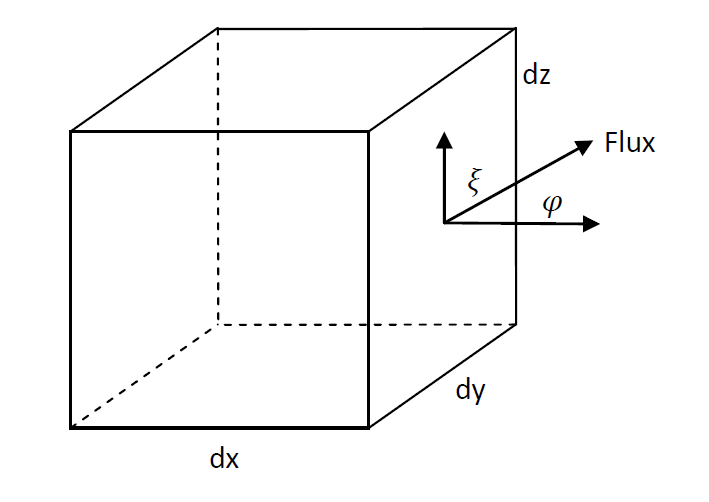
The flux is a vector, because it has both magnitude and direction:
\[ \vec{F}_{\text{flux}} = \vec{F}(x,y,z,t) \tag{1} \]
Flux through a surface
Consider now the right side of the cube, a plane parallel to the \(y\)-\(z\) plane. The flux through this surface is determined by the component of \(\vec{F}\) perpendicular to that plane.
If \(\xi\) is the angle between \(\vec{F}\) and the surface, then:
\[ \vec{F}_{\text{right}} = \vec{F} \,\sin\xi \, dy\,dz \tag{2} \]
We represent the surface as a vector \(d\vec{A}\) perpendicular to the plane:
\[ d\vec{A} = \vec{dy} \times \vec{dz}, \qquad |dA| = \sin\xi \, dy\,dz \tag{3} \]
The flux through the right side is then:
\[ \vec{F}_{\text{right}} = \vec{F} \sin\xi \, dy\,dz = \vec{F} \cos\!\left(\tfrac{\pi}{2}-\xi\right) dA = \vec{F} \cos\varphi \, dA = \vec{F}\cdot d\vec{A} \tag{4} \]
Here \(d\vec{A}\) is perpendicular to the surface, and \(\varphi\) is the complementary angle of \(\xi\). We recognize the dot product:
\[ Flux_{\text{right}}=\vec{F}d\vec{A}\,\cos\phi=\vec{F}\cdot d\vec{A} \tag{5} \]
Flux through the total surface of the cube
For a finite cube, the total flux is the sum of the contributions from all six faces:
\[ F_{\text{cube}} = \sum_{\text{all faces}} \vec{F}\cdot d\vec{A} \tag{6} \]
We can write this as a single integral over the closed surface:
\[ F_{\text{cube}} = \oint_{\partial V} \vec{F}\cdot d\vec{A} \tag{7} \]
Alternative approach: flux as a limit
In the \(x\)-direction, the incoming flux is:
\[ F_{\text{left}} = F_x \, dy\,dz \tag{8} \]
The flux leaving the right side is:
\[ F_{\text{right}} = (F_x + dF_x)\, dy\,dz \tag{9} \]
The net flux in the \(x\)-direction:
\[ F_x^{\text{net}} = F_{\text{right}} - F_{\text{left}} = dF_x\, dy\,dz \tag{10} \]
Similarly:
\[ F_y^{\text{net}} = dF_y\, dx\,dz, \qquad F_z^{\text{net}} = dF_z\, dx\,dy \tag{11–12} \]
The total flux through the cube:
\[ F_{\text{cube}} = dF_x\,dy\,dz + dF_y\,dx\,dz + dF_z\,dx\,dy \tag{13} \]
Rewritten using partial derivatives:
\[ F_{\text{cube}} = \left( \frac{\partial F_x}{\partial x} + \frac{\partial F_y}{\partial y} + \frac{\partial F_z}{\partial z} \right) dx\,dy\,dz \]
\[ F_{\text{cube}} = (\vec{\nabla}\cdot\vec{F})\, dV \tag{15} \]
The operator ∇
\[ \vec{\nabla} = \frac{\partial}{\partial x}\,\hat{e}_x + \frac{\partial}{\partial y}\,\hat{e}_y + \frac{\partial}{\partial z}\,\hat{e}_z = \left( \frac{\partial}{\partial x}, \frac{\partial}{\partial y}, \frac{\partial}{\partial z} \right) \tag{14} \]
Then equation (13) becomes:
\[ F_{\text{cube}} = (\vec{\nabla}\cdot\vec{F})\, dV \tag{15} \]
Net flux through the cube
By integrating over the entire volume of the cube we find:
\[ F_{\text{cube}} = \iiint_{\text{cube}} (\nabla \cdot \vec{F})\, dV \tag{16} \]
Gauss's Theorem
Equation (7) gave the flux through the closed surface:
\[ F_{\text{cube}} = \oint_{\partial V} \vec{F}\cdot d\vec{A} \]
Equation (16) gave the same flux as a volume term:
\[ F_{\text{cube}} = \iiint_V (\vec{\nabla}\cdot\vec{F})\, dV \]
Since both expressions describe the same flux, it follows:
\[ \oint_{\partial V} \vec{F}\cdot d\vec{A} = \iiint_V (\vec{\nabla}\cdot\vec{F})\, dV \tag{17} \]
Since the volume was arbitrary (not necessarily a cube), this holds for any closed volume:
\[ \oint_{\partial V} \vec{F}\cdot d\vec{A} = \iiint_V (\vec{\nabla}\cdot\vec{F})\, dV \tag{18} \]
This is Gauss's Theorem (also called the Divergence Theorem).
Special case: zero flux
If the net flux through the closed surface is zero:
\[ \oint_{\partial V} \vec{F}\cdot d\vec{A} = 0 \]
then from Gauss's theorem:
\[ \iiint_V (\vec{\nabla}\cdot\vec{F})\, dV = 0 \tag{19} \]
Since the volume is arbitrary:
\[ \vec{\nabla}\cdot\vec{F} = 0 \tag{20} \]
Written in components:
\[ \frac{\partial F_x}{\partial x} + \frac{\partial F_y}{\partial y} + \frac{\partial F_z}{\partial z} = 0 \tag{21} \]
In Einstein notation (summing over repeated index \(\alpha\)):
\[ \frac{\partial F_\alpha}{\partial x_\alpha} = 0 \tag{22} \]