Appendix 10 — Specific Angular Momentum
In this document, especially where we use the Schwarzschild equation, the term angular momentum is used in the form:
\[ L = m r^{2}\frac{d\phi}{dt}. \]
Since: \[ L = m v r = m r v = m r \left(r\frac{d\phi}{dt}\right) = m r^{2}\frac{d\phi}{dt}, \] this resembles classical angular momentum.
However, it is not the actual two-body angular momentum, but an approximation. Here is the explanation.
The Two-Body Problem
In the Schwarzschild formula we consider a particle moving in the gravitational field of a massive body. The reference frame is the center of that massive body. This is essentially a two-body problem.
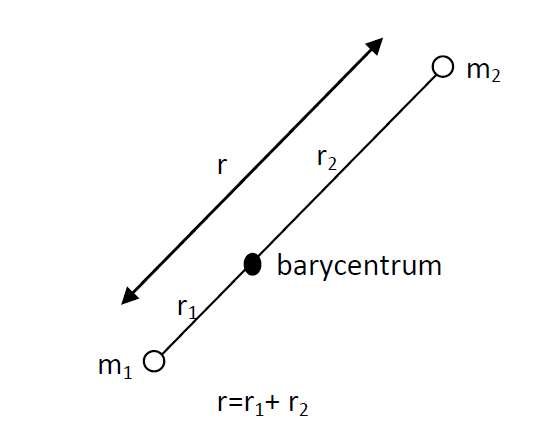
The two bodies rotate around their common center of mass (barycenter). For circular orbits:
\[ m_{1}\frac{v_{1}^{2}}{r_{1}} = m_{2}\frac{v_{2}^{2}}{r_{2}}. \tag{1} \]
Since the periods must be equal:
\[ T = \frac{2\pi r_{1}}{v_{1}} = \frac{2\pi r_{2}}{v_{2}} \quad\Rightarrow\quad \frac{v_{1}}{v_{2}} = \frac{r_{1}}{r_{2}}. \tag{2} \]
From this it follows:
\[ v_{1} = \frac{r_{1}}{r_{2}} v_{2} = \frac{r_{1}}{r_{2}}(v - v_{1}), \tag{3} \]
so: \[ v_{1} = \frac{r_{1}}{r} v, \qquad v_{2} = \frac{r_{2}}{r} v, \tag{4–5} \] where \(r = r_{1} + r_{2}\).
The relative velocity is: \[ v = v_{1} + v_{2}. \tag{6} \]
Relation Between Masses and Distances
Substitute (3) into (1):
\[ \frac{m_1v^2_1}{r_1}=\frac{m_1v^2_2}{r_1}\left(\frac{r_1}{r_2}\right)^2=\frac{m_2v^2_2}{r_2} \Rightarrow \frac{m_1}{r_1}\left(\frac{r_1}{r_2}\right)^2=\frac{m_2}{r_2} \]\[\Rightarrow m_{1} r_{1} = m_{2} r_{2}. \tag{7} \]
Thus:
\[ r_{2} = \frac{m_{1}}{m_{1} + m_{2}}\, r, \qquad r_{1} = \frac{m_{2}}{m_{1} + m_{2}}\, r. \tag{8} \]
Angular Momentum of Both Bodies
The angular momentum of \(m_{2}\) with respect to \(m_{1}\):
\[ L_{2} = m_{2} v_{2} r_{2} = m_{2}\frac{m_{1}}{m_{1}+m_{2}} r_2 v = m_2\left(\frac{m_1}{m_1+m_2}\right)^2 v r \tag{9} \]
In terms of the angular velocity \(\omega = v/r\):
\[ L_{2} = \frac{1}{m_2}\left(\frac{m_{1} m_{2}}{m_{1}+m_{2}}\right)^2\, \omega r^{2} \tag{10} \]
Similarly: \[ L_{1} = \frac{1}{m_1}\left(\frac{m_{1} m_{2}}{m_{1}+m_{2}}\right)^2\, \omega r^{2} \tag{11} \]
The total angular momentum is thus:
\[ L = L_{1} + L_{2} = \frac{m_{1} m_{2}}{m_{1}+m_{2}}\, \omega r^{2}. \]
Or in Schwarzschild form: \[ L = \frac{m_{1} m_{2}}{m_{1}+m_{2}}\, r^{2}\frac{d\phi}{d\tau}. \tag{12} \]
Reduced Mass
We define the reduced mass:
\[ m = \frac{m_{1} m_{2}}{m_{1} + m_{2}}. \tag{13} \]
The specific angular momentum is then:
\[ h = \frac{L}{m} = r^{2}\frac{d\phi}{d\tau}. \tag{14} \]
Limit of a Very Large Central Mass
If \(m_{1} = M\) is a very large mass (e.g., a star or black hole) and \(m_{2}\) is a small particle:
\[ m = \frac{m_{2} M}{M + m_{2}} \approx m_{2}. \tag{15} \]
Thus, when \(M \gg m_{2}\), the angular momentum is determined by the particle's mass alone. This justifies the usual Schwarzschild form:
\[ L = m r^{2}\frac{d\phi}{d\tau}. \]
The specific angular momentum: \[ h = r^{2}\frac{d\phi}{d\tau} \] is then exactly the correct quantity to use in the Schwarzschild equation.