Appendix 8 — Tidal Forces
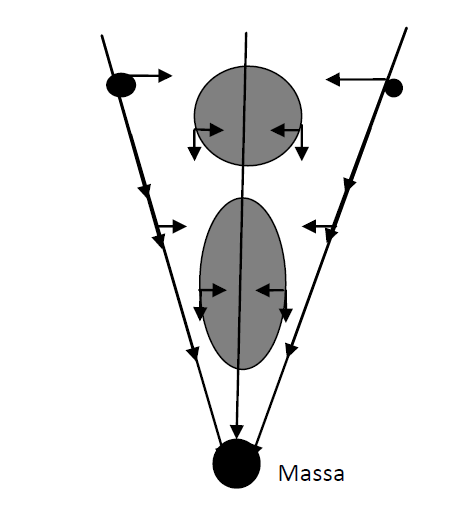
The field lines of the gravitational field generated by a mass are not parallel but are radially directed toward the center of that mass. The magnitude of the gravitational acceleration decreases with the square of the distance from the center:
\[ |\vec{g}(r)| = \frac{GM}{r^{2}}. \]
When an extended body (shown here as a gray object) is placed in this field, it does not experience the same force everywhere. The gravitational forces can be decomposed into:
- horizontal components — which compress the body,
- vertical components — which stretch the body in the direction of the mass.
This occurs because the gravitational field becomes stronger as one approaches the mass. The difference in force between the near and far sides of the body produces a tidal force.
Because the field lines are radially oriented, the forces acting on different points of the body do not point in the same direction. This leads to deformation: compression in the transverse direction and stretching in the radial direction.
Tidal forces under extreme conditions
In the case of a black hole, tidal forces become extremely large. The radial component of gravity increases so strongly that a body approaching too closely is stretched into a long, thin structure.
This phenomenon is known as:
\[ \text{“spaghettification”}. \]
It is a direct consequence of the enormous gradient of the gravitational field near the singularity.