Appendix 9 — Special Relativity
In Special Relativity, Einstein considered only coordinate systems that move uniformly, i.e., with constant velocity relative to each other. The influence of masses, and thus gravity, was not taken into account.
The assumptions on which Special Relativity (SR) is based are:
- The maximum possible speed, in any coordinate system, is the speed of light \(c = 299\,792\,458\ \text{m/s}\).
- The laws of physics are valid in every uniformly moving coordinate system.
In Newton’s approach, time intervals were identical in the “rest frame” and in the moving frame. However, Special Relativity showed that:
- time intervals in a moving frame are smaller than in a rest frame (time dilation),
- the length of an object decreases in the direction of motion (length contraction).
Both effects follow from the observation that the speed of light in vacuum is always the same in every frame, regardless of the velocity of the frame.
In this chapter we summarize several points that are frequently used in SR and that are relevant for applications in General Relativity (GR).
We begin by establishing the relationship between two coordinate systems that move with constant velocity relative to each other. This relationship is known as the Lorentz transformation.
Appendix 9.1 — Simple Derivation of the Lorentz Transformation
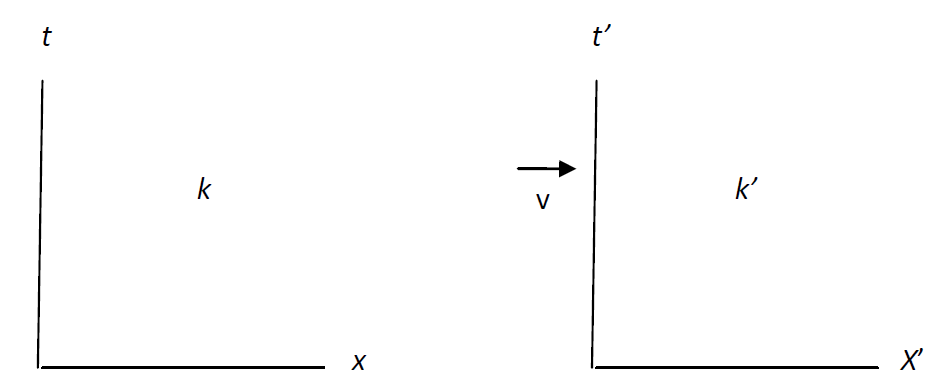
Coordinate system k’ moves uniformly with velocity v relative to coordinate system k.
We consider two coordinate systems whose origins move with constant velocity \(v\) relative to each other, along the \(x\)- and \(x'\)-directions respectively.
Although the coordinate systems are four-dimensional \((t, x, y, z)\), only the \(t\)- and \(x\)-axes are shown for simplicity, since there is no motion in the \(y\)- and \(z\)-directions.
A light signal emitted at time \(t = t' = 0\) in the positive \(x\)-direction satisfies in frame \(k\):
Since the same light signal also propagates with speed \(c\) in frame \(k'\), we have:
All spacetime points (events) that satisfy (\ref{eq:R01}) must also satisfy (\ref{eq:R02}). This is guaranteed if:
where \(\lambda\) is a constant. If \(x - ct = 0\), then automatically \(x' - ct' = 0\), regardless of the value of \(\lambda\).
Light signal in the negative direction
For a light signal moving along the negative \(x\)-axis, we have in \(k\):
and in \(k'\):
Therefore:
with \(\mu\) a second constant.
Linear combination of the two conditions
By adding and subtracting (\ref{eq:R03}) and (\ref{eq:R06}), and introducing the constants
we obtain:
This is the general linear form of the Lorentz transformation, where the constants \(a\) and \(b\) still need to be determined.
Determination of the ratio \(b/a\)
For the origin of \(k'\) we always have:
Substituting into the first equation of (\ref{eq:R08}) gives:
The origin of \(k'\) therefore moves in \(k\) with velocity:
This value \(v\) is the relative velocity of the two frames. The same value is obtained when calculating the velocity of any other point of \(k'\) relative to \(k\), or vice versa.
The principle of relativity tells us that — as observed from \(k\) — the length of a measuring rod at rest in \(k'\) must be exactly equal to the length of a measuring rod at rest in \(k\), as observed from \(k'\).
To see how the points on the \(x'\)-axis appear from \(k\), we take a snapshot of \(k'\) from \(k\). This means we choose a fixed value of \(t\), for example:
For this value, the first equation of (\ref{eq:R08}) gives:
Two points on the \(x'\)-axis that are separated by a distance \(x' = L\) in \(k'\), are in our snapshot separated by:
Snapshot from \(k'\): \(t' = 0\)
If the snapshot is taken from \(k'\), i.e., at \(t' = 0\), then from the second equation of (\ref{eq:R08}) we obtain:
Substituting into the first equation of (\ref{eq:R08}):
From equation (\ref{eq:R11}):
Therefore, two points on the \(x\)-axis, separated by a distance \(L\) in \(k\), are represented in the snapshot from \(k'\) by:
Equality of the two snapshots
According to the principle of relativity, both snapshots must be identical:
Thus, according to equations (\ref{eq:R14}) and (\ref{eq:R19}):
After simplification:
Thus:
The Lorentz transformation
By substituting these values of \(a\) and \(b\) into (\ref{eq:R08}), we obtain:
And:
Thus, the full Lorentz transformation is:
Lorentz transformation for events on the x-axis
From the earlier derivation, the Lorentz transformation follows:
This transformation satisfies the invariance of the spacetime interval:
Extension to events off the x-axis
For motion purely along the x-axis, the transformations for the other coordinates remain unchanged:
With (\ref{eq:R27}) and (\ref{eq:R29}), we satisfy the postulate that the speed of light in vacuum has the same value in every inertial frame.
Verification with a light signal
A light signal emitted from the origin of \(k\) at time \(t = 0\) satisfies:
Squaring gives:
According to the principle of relativity, the same signal in \(k'\) must satisfy:
To make (\ref{eq:R32}) a consequence of (\ref{eq:R31}), we must have:
But for points on the x-axis, we already have (8a), thus:
This shows that the Lorentz transformation (\ref{eq:R27})– (\ref{eq:R29}) leaves the speed of light invariant.
General form of the Lorentz transformation
The Lorentz transformation derived above applies to the case where:
- the axes of \(k\) and \(k'\) are parallel,
- the relative velocity \(v\) lies along the x-axis.
However, this is not a restriction. In general, any Lorentz transformation can be constructed from:
- a Lorentz transformation in the specific sense (translation along one axis),
- followed by a purely spatial rotation of the coordinate system.
This corresponds to replacing the rectangular coordinate system with a new system whose axes point in different directions.
In this way, we obtain the full Lorentz group, consisting of all combinations of transformations and rotations.
The generalized Lorentz transformation
Mathematically, the generalized Lorentz transformation can be characterized as follows: it expresses \(x', y', z', t'\) as linear homogeneous functions of \(x, y, z, t\), such that the relation
is identically satisfied. That is: when we substitute the expressions for \(x', y', z', t'\) in terms of \(x, y, z, t\) into the left-hand side, it becomes identical to the right-hand side.
Use of an imaginary time coordinate
We can characterize the Lorentz transformation even more simply by introducing the imaginary quantity \(i\), where \(i\) denotes \(\sqrt{-1}\). Define:
And analogously for the primed system \(k'\). Then the transformation condition becomes:
With this choice of “coordinates”, equation (\ref{eq:R35}) is transformed into (\ref{eq:R37}).
We see that the imaginary time coordinate \(x_4\) appears in the transformation condition in exactly the same way as the spatial coordinates \(x_1, x_2, x_3\). This reflects the relativistic insight that time and space are treated on equal footing in the laws of nature.
Minkowski space
A four-dimensional continuum described by the coordinates \((x_1, x_2, x_3, x_4)\) was called the world by Minkowski. An event is called a world point.
The four-dimensional “world” shows a strong analogy with three-dimensional Euclidean space. In Euclidean geometry, a rotation satisfies:
The analogy with (\ref{eq:R37}) is complete: the Lorentz transformation corresponds to a “rotation” in four-dimensional Minkowski space, where the time coordinate carries an imaginary component.
Appendix 9.2 — Alternative derivation of time dilation and length contraction
To illustrate the effects of Special Relativity on time and length, we use a light signal in a rapidly moving object, for example a rocket. We consider two reference frames:
- our stationary reference frame with time \(t\),
- the reference frame of the rocket with time \(t'\).
Time dilation
First, we send a light pulse perpendicular to the direction of motion of the rocket. In the rocket frame, the light pulse moves from the bottom to the top of the rocket. The height of the rocket in that frame is \(h\), and the light pulse travels this distance in time \(t'\):
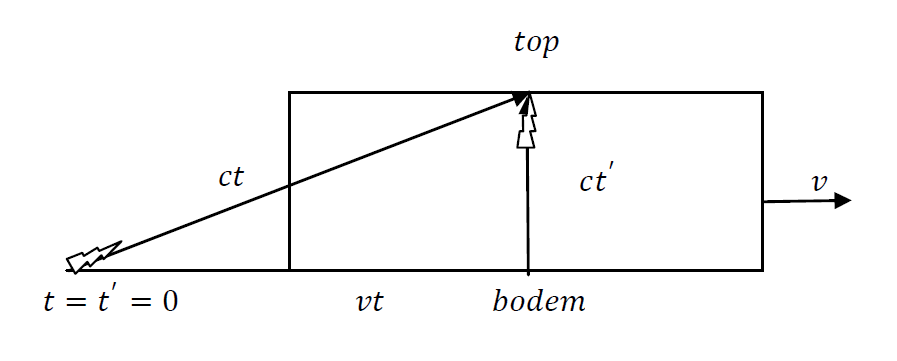
From our stationary reference frame, the rocket appears to move to the right with velocity \(v\). The light pulse still travels the vertical distance \(h\), but because the rocket moves horizontally, the light follows a diagonal path in our frame. The horizontal displacement of the rocket is \(vt\), while the vertical displacement of the light remains \(h\). The total distance of the light in our frame is \(ct\). From the Pythagorean relation it follows:
This shows that a clock in the moving frame runs slower: the time \(t'\) in the rocket is shorter than the time \(t\) in our stationary frame. This is the phenomenon of time dilation.
Length contraction
When measuring a length in a reference frame, the positions of the two endpoints must be determined at the same time in that frame. In our stationary frame, the positions of the rear and front of the rocket are therefore recorded simultaneously at time \(t\). In the rocket frame itself, the positions of the two endpoints are recorded at the same moment \(t'\).
Starting from the Lorentz transformations:
Since \(x'\) and \(t'\) are functions of \(x\) and \(t\), it also follows that:
To measure the length in our frame, we must keep \(t\) constant, so \(dt=0\), which gives:
The length in the rocket is \(L_0\), since it is at rest in that frame, and we then observe the length in our frame as:
Due to the relativity of simultaneity, events that are simultaneous in one frame are not necessarily simultaneous in another frame. This explains why a moving rocket appears shorter from our perspective, with length \(L\), than the proper length \(L_0\) measured in the rocket frame.
Summary of the results
- A clock in a moving frame runs slower (time dilation).
- A moving object is shorter in the direction of motion (length contraction).
- Length contraction arises from the combination of motion and the relativity of simultaneity.
Appendix 9.3 Symmetry of Lorentz transformations in spacetime
When a Lorentz transformation is applied due to a constant velocity \(v\) in the x-direction, formally only the coordinates \(x\) and \(t\) are directly affected:
At first glance, it appears that only the \(x - t\) plane changes, while the other spatial coordinates \(y\) and \(z\) remain unchanged. However, this is only partially correct.
When we consider spacetime as a four-dimensional structure, we see that all processes involving the time component \(t\) are indirectly affected. For example:
- A clock located at a fixed \(y\)-position runs slower for a stationary observer, just as a clock at a fixed \(x\)-position does.
- Similarly, events in the \(y - t\) or \(z - t\) planes are affected, because the time \(t\) is transformed.
Conversely, in planes such as \(y - x\) or \(z - x\), the coordinate \(x\) is directly transformed. Here too, spacetime is altered, although the effect is less directly visible.
The key insight is that the Lorentz transformation is not limited to the plane of motion. Every four-dimensional combination involving \(x\) or \(t\) is affected. This reveals a structural symmetry: although \(y\) and \(z\) themselves do not change, all processes in these directions evolve according to a transformed time or spatial component. The entire spacetime is restructured, and with it the physical descriptions within that frame.
Appendix 9.4 Trigonometric Tools
Since trigonometric formulas are frequently used in special relativity, we provide a brief overview of several of them and how they can be derived easily.
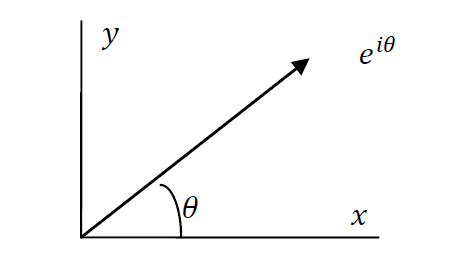
By definition:
Where:
Justification of this equation:
We first consider a function:
Its derivative is:
Thus, the derivative of an exponential function is a factor \(\alpha\) times the function itself.
Complex trigonometric function
Now consider the function:
Its derivative is:
Thus:
From this it follows that:
For \(\alpha = 1\), we obtain the well-known Euler equation:
Derived trigonometric formulas
From (\ref{eq:R64}) it follows directly:
By adding (\ref{eq:R64}) and (\ref{eq:R65}):
By subtracting (\ref{eq:R64}) and (\ref{eq:R65}):
Furthermore:
and:
Hyperbolic functions
We define:
From this it follows:
Furthermore:
Thus:
These relations form the basis for the use of hyperbolic functions in special relativity, particularly in describing Lorentz boosts via rapidity.
Appendix 9.5 — Velocity addition
We consider two coordinate systems \(A\) and \(B\) moving with constant velocity \(v\) relative to each other. The axes are chosen such that the relative motion occurs along the \(x\)-axes.
In system \(A\), an object moves with velocity \(V'_x, V'_y, V'_z\). We now want to determine the velocity of this object relative to system \(B\).
According to Newton, the velocity in the \(x\)-direction would simply be:
Lorentz transformation
We begin with the Lorentz transformations:
where:
The inverse transformation is:
Velocity in the \(x'\)-direction
Take the derivative of (\ref{eq:R76}):
Now take the derivative of (\ref{eq:R75}):
Thus:
Substitute (\ref{eq:R84}) into (\ref{eq:R82}):
This is the relativistic velocity addition in the \(x\)-direction.
Result
This replaces the Newtonian addition \(V'_x = V_x - v\).
The velocities in the other directions become:
These formulas show that velocities do not simply add in relativity, but are influenced by both the Lorentz factor and the projection of the velocity onto the direction of motion.
From equation (\ref{eq:R86}) we already had:
Velocity in the \(y'\)-direction
From equation (\ref{eq:R84}):
thus:
Velocity in the \(z'\)-direction
In an identical manner, we obtain:
Interpretation of equation (\ref{eq:R84})
From (\ref{eq:R84}):
In the special case where \(V'_x = 0\), we have \(V_x = v\). Then:
Thus:
and therefore:
This is again time dilation.
Back to the general case
From (\ref{eq:R86}):
Solving for \(V_x\) gives:
This is the inverse relativistic velocity addition.
In compact form:
For the other components, we obtain analogously:
and:
Summary
The relativistic velocity addition is:
and the inverse transformation:
For the \(z\)-component, we obtain in the same way:
According to Newton, in the \(x\)-direction we would simply have an added velocity:
But according to special relativity, this is corrected to:
In general, when the term \(\frac{v V'_x}{c^{2}}\) is very small, the relativistic result can be approximated by the Newtonian result:
Appendix 9.6 Collisions
Consider a perfectly elastic collision between two identical particles; an elastic collision is a collision without loss of kinetic energy. The initial velocities of the particles are \(\vec{u_1}\) and \(\vec{u_2}\), and after the collision \(\vec{v_1}\) and \(\vec{v_2}\). Due to momentum conservation:
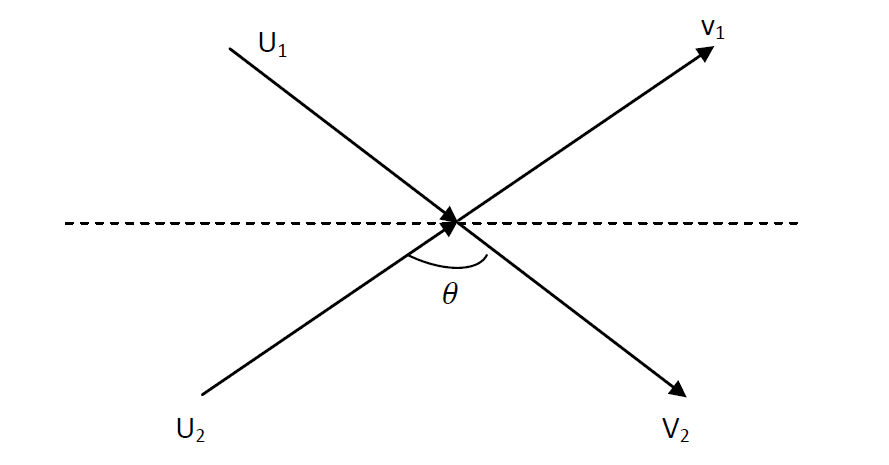
First, we consider the collision from a coordinate system moving with particle one. Then particle 1 moves upward with velocity \(w_1\) and downward with \(w_2\). These velocities are equal in magnitude but opposite in direction. Particle 2 has velocity \(V\) with an x-component \(u\) and a y-component \(v\).
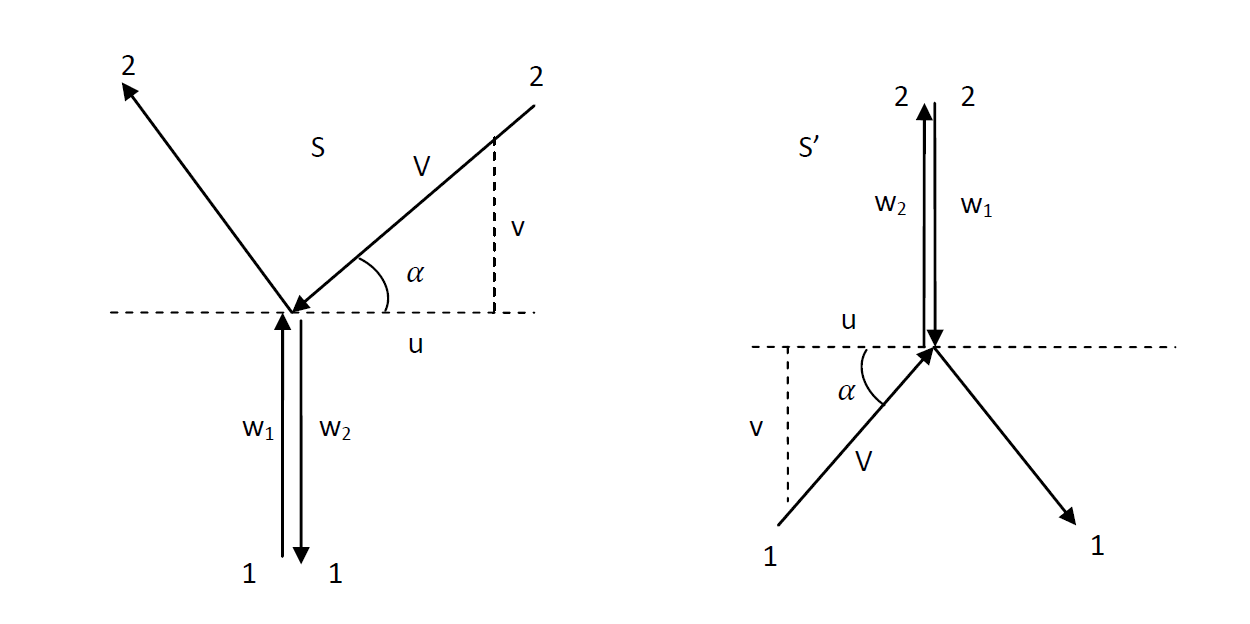
Relation between the y-components of momentum
We now want to find the relation between the y-components of the momentum of particles 1 and 2 in system \(S\), i.e., between \(w\) and \(v\).
In the previous section, we found the relation:
Since in this case:
By symmetry, \(w\) is the velocity of particle 1 in system \(S\) and the velocity of particle 2 in system \(S'\). Conversely, \(v\) is the y-component of particle 2 in \(S\) and of particle 1 in \(S'\).
Total velocity
The total velocity of the moving particle in \(S\) and in \(S'\) is the same:
Momentum conservation in the y-direction
Momentum conservation in the y-direction gives:
From this follows:
Thus:
This result shows that the Lorentz factor \(\gamma\) arises directly from momentum conservation in a collision viewed symmetrically from two inertial frames.
Limit of small velocities
Now suppose that the velocity \(w\) is very small. In this limit:
In that case, relativistic effects can be neglected and the classical expression for momentum is recovered.
Since:
Due to momentum conservation, the definition of momentum must be modified. The relativistic momentum is therefore:
Appendix 9.7 — The Energy of a Moving Object
Using a thought experiment, Einstein showed that energy and mass are equivalent via the relation \(E=mc^2\). We have shown that for an object moving with velocity, momentum must be adapted to the relativistic description:
Appendix 9.8 — Energy-Momentum Vector
As found by Minkowski, the spacetime interval is:
We write this as:
Since:
Derivation of the energy–momentum relation
Start again from (\ref{eq:R129}):
Multiply by the rest mass \(m_{0}^{2}\):
Since:
Now define the four-momentum:
with:
Then the Minkowski norm becomes:
Or more compactly:
Thus:
and for positive energy:
We previously found that:
From the relation:
After further division:
But:
Thus:
Or, as commonly written:
where:
Appendix 9.8.1 Alternative derivation of the energy–momentum–mass relation
We had:
Here:
Now, using the above, we examine what happens:
Thus:
Appendix 9.8.2 — Classical proof of energy conservation
The total mechanical energy of a particle is the sum of the kinetic energy \(K\) and the potential energy \(U\):
Take the time derivative (one-dimensional motion):
The force associated with a potential energy \(U(x)\) is:
Thus:
According to Newton’s second law:
Thus:
Therefore:
The total mechanical energy is thus conserved.
Appendix 9.9 Derivation of \(E=mc^2\)
Einstein’s thought experiment with a light pulse in a box
Einstein derived the equation \(E = mc^{2}\) through an elegant thought experiment. Consider a stationary box floating freely in space, without the influence of gravity or external forces.
On the left side of the box, a photon is emitted moving to the right. Due to conservation of momentum, the box moves slightly to the left. When the photon reaches the right wall, it transfers its entire momentum to the box, causing the box to stop moving.
The photon has moved, and the box has also moved, but there are no external forces present. Therefore, the center of mass of the total system must remain constant.
Relativistic energy of the photon
From Appendix 9.6 (equation (\ref{eq:R149})) we know:
For a photon \(m_{0} = 0\), so:
The momentum of the photon is therefore:
Momentum of the box
The box with mass \(M\) moves slightly to the left with velocity \(v\). The momentum of the box is:
During the time \(\Delta t\) it takes the photon to reach the right side, the box moves a distance \(\Delta x\). The velocity of the box is:
Due to conservation of momentum:
Thus:
The length of the box is \(L\), so the time it takes the photon to reach the other side is:
Thus:
Center of mass of the system
Now suppose hypothetically that the photon has a small mass \(m\). Then we can determine the center of mass of the system. If the position of the box is \(x_{1}\) and the position of the photon is \(x_{2}\), then the center of mass is:
Since there are no external forces, this center of mass must remain constant:
The photon starts at \(x_2 = 0\), so we obtain:
Now we get:
With some rearrangement we obtain the famous relation:
Remark — precise treatment of the photon path
In the original derivation it is assumed that the photon travels a distance L. But in reality, the box moves a small distance \(\Delta x\) in the opposite direction during the photon’s flight. The effective path of the photon is therefore:
This leads to an adjusted travel time:
The momentum balance gives:
Substituting \(\Delta t\) gives:
Center-of-mass condition
The center of mass of box + photon must remain constant:
This gives:
Thus:
But earlier we found:
Therefore:
The factor in parentheses is nonzero, so:
Conclusion
Even when we:
- include the displacement of the box \(\Delta x\),
- use the shortened photon path,
- include Lorentz contraction,
the derivation still leads exactly to:
Appendix 9.10 — Applications
Appendix 9.10.1 — Nuclear Fusion and Fission
When a proton \(p\) and a neutron \(n\) are brought together, they can fuse into a deuterium nucleus \(d\). The masses of the particles involved are:
Unit: MeV/\(c^{2}\)
From the relation \(E = mc^{2}\) it follows that mass can be expressed as energy divided by \(c^{2}\). In particle physics, the electronvolt (eV) is therefore often used:
The unit MeV/\(c^{2}\) is thus a practical measure of mass.
Energy released in fusion
Since the mass of the deuteron is smaller than the sum of the masses of the proton and neutron, energy must have been released. If \(p\) and \(n\) combine with negligible velocity:
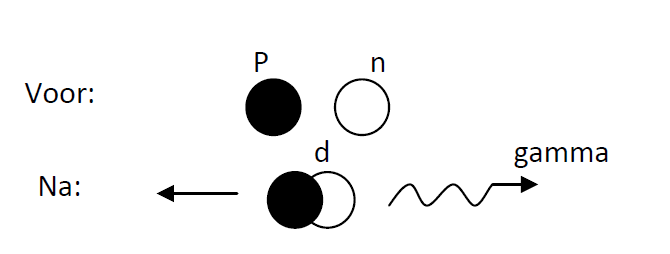
This energy is released in the form of a photon:
A photon is massless and carries energy and momentum. To ensure conservation of momentum, the formed deuteron moves in the opposite direction of the photon. Since the mass of \(d\) is large, the kinetic energy of \(d\) is very small:
Nuclear fusion
The reaction described above is an example of nuclear fusion. Light nuclei can fuse into heavier nuclei while releasing energy. All nuclei up to iron (\(^{56}\text{Fe}\)) can be formed via fusion with net energy production.
Nuclear fission
For very heavy nuclei, such as uranium, the opposite holds: the total mass of the nucleus is greater than the sum of the masses of the individual nucleons. Therefore, energy is released when such heavy nuclei are split:
nuclear fission.
This explains why:
- fusion releases energy for light elements,
- fission releases energy for heavy elements.
Appendix 9.10.2 — Driving an Electric Car on 1 gram of Hydrogen via Nuclear Fusion
Here we investigate how much energy is released during hydrogen fusion as in the Sun, where four hydrogen atoms fuse into one helium atom. A small fraction of the mass disappears and is converted into energy according to \(E = mc^{2}\). We then determine how many kilometers an electric car could theoretically drive using this energy.
1. Energy yield of nuclear fusion
Fusion in the Sun proceeds via the proton–proton cycle. The net reaction is:
The mass of four hydrogen atoms is greater than that of one helium nucleus. The mass difference is released as energy. Per fusion of four hydrogen atoms, approximately:
In 1 gram of hydrogen there are approximately \(6.022\times 10^{23}\) (Avogadro’s number) hydrogen atoms (1 mole). Thus, in 1 gram of hydrogen we have
Each fusion reaction yields 26.7 MeV of energy, so total energy:
2. Conversion from MeV to Joule
A Joule is equal to moving a charge of 1 Coulomb through a potential of 1 Volt. Thus:
Then:
Thus per 1 gram of hydrogen, the total energy in Joules is:
3. Calculation of the energy:
This is the energy released in this process, where a small portion of the mass
is converted into energy.
For comparison, we can consider the theoretical calculation where 1 gram of matter is fully converted according to \(E=mc^2\):
4. Alternative mass defect calculation
In fusion, 4 moles of hydrogen are converted into 1 mole of helium:
Mass difference:
Energy released:
5. Energy consumption of an electric car
Electric cars consume on average:
6. Theoretical driving range (100% efficiency)
7. Realistic efficiency
- Fusion → electricity efficiency: 40%
- Electric drivetrain efficiency: 90%
Total efficiency:
Usable energy:
8. Practical driving range
Thus, an electric car can theoretically:
With an average annual mileage of 15,000 km, this means:
In other words: with 1 gram of hydrogen you can drive electrically for about 25 years.
Appendix 9.11 — Relativistic Electromagnetism
(Calculations based on Richard Feynman, Feynman Lectures on Physics, Vol. II, Chapter 13 )
Appendix 9.11.1 — Introduction
The term electromagnetism suggests that there are two types of fields: an electric field and a magnetic field, each with its own sources. In reality, we know only one fundamental source: electric charge.
Electric charges — electrons with charge \(-e\) and protons with charge \(+e\) — are the only known sources of the electric field. To date, no magnetic monopoles have been found that could serve as a source of a magnetic field.
It appears that magnetic fields always arise from:
- moving electric charges (current), or
- time variations in the electric field.
Even at the quantum level, magnetic fields result from electrical phenomena, such as the spins of electrons and atoms.
Therefore, one can argue that the magnetic field model is an extremely useful mathematical tool for describing electromagnetic phenomena, but that the underlying physical phenomenon is entirely electrical in nature: an electric field and its variation in space and time.
Appendix 9.11.2 — Calculations
When analyzing a current-carrying wire, we normally use the Maxwell equations to determine both the electric and magnetic fields.
An alternative — and in a relativistic context very insightful — approach is to perform the entire calculation based solely on the electric field, and to treat the magnetic field as a relativistic byproduct.
This idea forms the core of Feynman’s treatment of electromagnetism: the magnetic field is what an electric field looks like when viewed from another inertial frame.
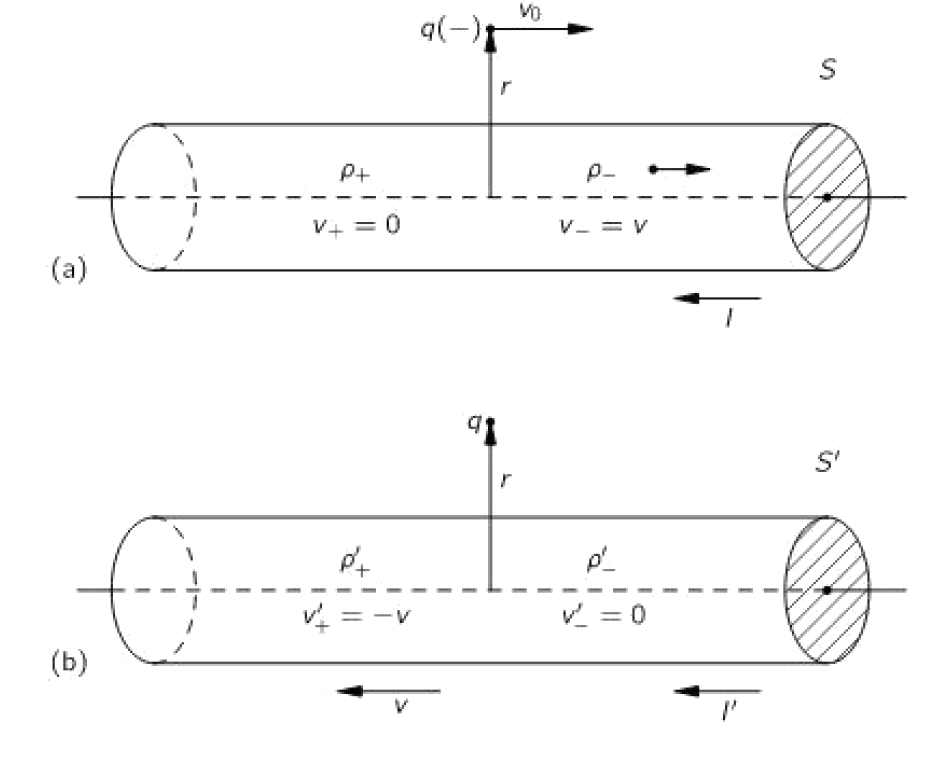
We consider a wire carrying an electric current and a test charge \(q\). The situation is observed in two different inertial frames:
- Frame S — the wire is at rest, the charge is moving.
- Frame S′ — the charge is at rest, the wire is moving.
Although the physical situation is the same, the fields in both frames will be observed differently. This is precisely where relativity and electromagnetism meet.
In the following sections, we will derive several fundamental formulas that show how electric fields and charge densities transform under Lorentz transformations, and how the magnetic field follows automatically from this.
Current density and charge distribution
The current density is the average flow velocity of the charges. Suppose there is a distribution of charges with an average velocity \(\vec{v}\). The charge \(\Delta q\) that passes through a surface element \(\Delta S\) in a time interval \(\Delta t\) is:
Here \(\rho\) is the charge density: charge per unit volume. The term \(\vec{v}\Delta t \cdot \Delta S\) can be interpreted as a volume. Thus, the charge is the charge density times the volume.
The charge per unit time is then:
Therefore we define the current density:
The total current through a surface \(S\) is:
Current carrier at rest
We now consider a wire that is at rest. The electrons (negative charges) move with velocity \(v\) to the right. The protons (positive charges) remain at rest in the wire.
A test particle with negative charge \(q^{-}\) moves with the same velocity as the electrons to the right. We observe everything in the frame where the wire is at rest.
The wire is electrically neutral:
Force on the test particle
The force on a charge is given by the Lorentz force:
The magnetic field around a long straight wire is:
Since the wire is neutral, the electric field outside the wire is zero:
The force on the test particle is then:
Since \(\vec{v}\) is perpendicular to \(\vec{B}\), we have \(\sin\varphi = 1\), so:
Charge density
The charge density is defined as:
If \(A\) is the cross-sectional area of the wire and \(L\) an arbitrary length along the wire, then the volume is:
When the wire is at rest:
This forms the basis for the relativistic analysis that follows: in one frame the wire is neutral, but in another frame — due to Lorentz contraction — the charge density changes, and an electric field arises that exactly corresponds to the magnetic effect in the original frame.
Relativistic analysis from the perspective of the test particle
We now consider the situation from the frame in which the test particle is at rest. In this frame, the wire moves to the left with velocity \(v\). The volume is determined by the cross-sectional area \(A\) and the length \(L\).
The length of a moving volume relative to a volume at rest is:
Since the electrons have the same velocity as the test particle, they are at rest in this frame. Thus:
The positive ions now move with velocity \(v\) to the left. Their length is Lorentz-contracted by the factor:
New charge density
In the rest frame of the wire, the external electric field was zero:
But in the frame of the test particle, the moving length is smaller, thus the moving volume is smaller, and therefore the charge density is larger.
The charge density of the electrons becomes:
The positive charge density becomes:
The total charge density is therefore:
Since \(\rho_{-} = -\rho_{+}\):
Rewrite this as:
Thus:
Charge in a length \(L\)
The volume of a length \(L\) of the wire is:
The total charge in this volume is:
Since \(\rho_{\text{net}} \neq 0\), the electric field outside the wire is no longer zero. It is perpendicular to the wire and behaves like the field of a charged line.
Volume of a cylindrical Gaussian surface
Consider a cylindrical tube around the wire, with:
- length \(L\),
- radius \(r\).
The lateral surface area is:
This will be used to determine the electric field via Gauss’s law:
In the next step, this leads to an electric field that exactly corresponds to the magnetic force in the original frame — a beautiful example of how magnetism is a relativistic effect.
Electric field in the rest frame of the test particle
From Gauss’s law, the electric field outside the wire follows:
Thus, the force on the test particle in this frame is:
For \(v \ll c\), this becomes:
Force in the original frame (magnetic)
In the rest frame of the wire, the force was:
Since the current density:
Now use:
Comparison of the two forces
From (\ref{eq:R248}) and (\ref{eq:R254}) it follows:
Or:
This is exactly what we expect: the force in the transverse plane (y-direction) transforms with a factor \(\gamma\).
Momentum relation in both frames
The forces act only in the transverse y-direction. Therefore, the change in momentum in the y-direction must be the same in both frames.
In the original frame:
In the frame of the test particle:
Since time runs slower for a moving particle:
Substitute this into the momentum equation:
Thus:
This confirms that the transverse momentum is invariant under Lorentz transformation.
And once again we see that the magnetic field in one frame is nothing more than an electric field in another frame — one of the most beautiful results of special relativity.
Relation between forces in both frames
From time dilation it follows:
The momentum change in both frames is:
Since transverse momentum is invariant:
It follows that:
Using the results from (\ref{eq:R250}) and (\ref{eq:R254}), we obtain:
Or:
This is exactly the relativistic relation between electric and magnetic forces.
Appendix 9.11.3 — Conclusion
We have found that we obtain the same physical result, regardless of whether we analyze the motion of a particle along a current-carrying wire in:
- a coordinate system at rest with respect to the wire, or
- a system at rest with respect to the particle.
In the first case, the force was entirely magnetic. In the second case, the force was entirely electric.
Since both descriptions lead to exactly the same momentum change, electric and magnetic fields must be manifestations of one and the same underlying relativistic field.
This demonstrates that:
This is one of the most beautiful and profound insights of special relativity, and forms the basis for the tensor formulation of the electromagnetic field.